
Parents are the primary decision-makers in the lives of their children. From education and healthcare to technology and entertainment, parents – not corporations, government bureaucracies, or media executives – have the responsibility to determine what is appropriate for their children. That is why Moms for Liberty is encouraging the Federal Communications Commission (FCC) to urge the TV Parental Guidelines Oversight Monitoring Board (TVOMB) to modernize television content ratings and give parents greater transparency, choice, and confidence when navigating children’s media.
The Media Landscape Has Changed. The Ratings System Should Too.
The television ratings system was created to give parents information about the programming entering their homes. Parents are already alerted to content involving violence, sexual situations, foul language, and other mature themes, but the way children consume entertainment has changed dramatically. Children now move seamlessly between traditional television, streaming platforms, tablets, phones, and on-demand programming. At the same time, children’s entertainment increasingly incorporates social and cultural themes that many families may consider sensitive, controversial, or inconsistent with their values.
The ratings system has not adequately kept pace.
Parents deserve meaningful information about all significant content their children may encounter—not just the categories the entertainment industry has traditionally chosen to identify.
New Research Shows Why Transparency Matters
Recent research from Concerned Women for America (CWA) illustrates the scope of the issue.
In December 2025, CWA released an analysis of 326 Netflix series rated for young audiences—TV-G, TV-Y, and TV-Y7. Researchers examined the programs for LGBTQ+ characters, themes, storylines, or messaging. CWA reported that 33% of the children’s series it reviewed contained such content. The percentage increased to 41% among G-rated series and 41% among TV-Y7-rated series. CWA’s research also identified a significant increase among more recently introduced programming. Of the children’s programs in its dataset that launched on Netflix in 2023, 14 contained LGBTQ+ content while nine did not.
The concern for parents is not simply that this content exists. The issue is whether parents are given adequate information to know it is there before their children encounter it.
A TV-G or TV-Y7 designation may tell a parent the general age group for which a program has been rated, but it does not necessarily tell a family whether that program contains discussions or depictions involving gender identity, sexual orientation, same-sex relationships, or related themes. That distinction matters.
Families may reach very different conclusions about what programming is appropriate for their children. But they cannot exercise meaningful choice when the information necessary to make that choice is missing.
Transparency Is Not Censorship
Moms for Liberty is not calling for controversial programming to be banned. Nor are we asking the government to determine which viewpoints families may or may not watch.
We are asking for transparency. A trustworthy ratings system should provide parents with objective, understandable information before their children encounter content. That includes meaningful notice when children’s programming addresses subjects such as gender identity, sexual orientation, and related social themes. When parents know what a program contains, they can decide for themselves whether it is appropriate for their child and consistent with their family’s priorities, beliefs, convictions, and developmental expectations. When important information is omitted or obscured, however, the ratings system can become a Trojan Horse, allowing controversial themes to reach young audiences without parents having meaningful notice beforehand. This undermines the very purpose of parental ratings.
Better Information for Parents Through a Reformed Ratings System
CWA’s research was followed in June 2026 by a Zogby Analytics poll commissioned by the organization examining parents’ views of children’s television ratings.
According to the poll, 87.1% of participating parents said it was either very important or somewhat important for children’s programs to include labels advising parents about content they might want to avoid—including violence, sexual content, and sensitive themes such as LGBTQ+ messaging or characters. That finding underscores a straightforward principle: parents want information so they can make decisions for themselves. A modern ratings system should provide it.
Three Principles for Reform
Moms for Liberty believes a modernized ratings system should be built around three principles: transparency, consistency, and accountability.
Transparency means parents receive clear and understandable information about significant themes and subject matter contained in programming intended for children and adolescents.
Consistency means families should receive comparable information regardless of whether a program is watched through broadcast television, cable, satellite, or a streaming service.
Accountability means the ratings process should incorporate perspectives beyond the entertainment industry itself. Parents, child-development professionals, educators, and other independent stakeholders should have meaningful representation in determining whether the system is actually serving families.
Modernization should also include stronger content descriptors, more effective parental-control technology, and greater independent oversight of ratings practices.
More Information Means More Parental Choice
There is an important distinction between restricting content and identifying content. Providing parents with additional information does not prohibit a television program from being produced, it does not prevent an adult from watching it, and it does not require every family to reach the same conclusion about whether the content is appropriate. What it does do, is that it simply allows parents to make that decision before someone else makes it for them – that is parental choice.
Parents routinely receive information that helps them make decisions for their children. Media should be no different. If parents can be alerted to violence, sexual content, or foul language, they should also be able to identify other significant themes they may want to consider before allowing their children to watch. Families may ultimately make different choices, but the important point is that those choices belong to families.
Put Parents Back at the Center
As entertainment options continue to evolve, the guiding principle of the ratings system should remain simple: empower parents.
Entertainment companies have their own creative, commercial, and institutional priorities, but parents have something entirely different – the responsibility to raise their children.
That is why parents must remain in the driver’s seat.
Moms for Liberty encourages the FCC, TVOMB, and the entertainment industry to modernize the ratings system so families have clear information, consistent standards, meaningful parental controls, and confidence that children’s content will not bypass parental awareness.
Transparency is not censorship. It is parental empowerment. Parents deserve to know what their children are watching while possessing the tools to make informed choices. In other words, parents – not the entertainment industry – should have the final say.
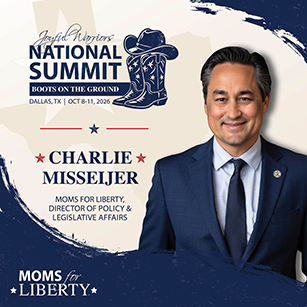
Charlie Misseijer is the Director of Policy & Legislative Affairs at Moms for Liberty and one of the speakers at the Moms for Liberty National Summit 2026 this October 8-11.